1.2 Where we are
Part 2 describes the production system. This page compares the testnet with that system and with each objective. Status is at 20 Nov 2026.
Progress against the objective
| Objective | Today | What remains |
|---|---|---|
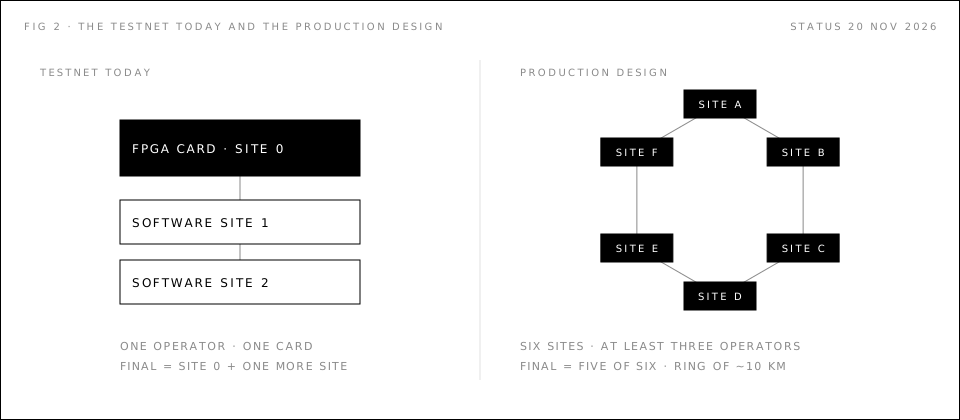
| Distributed sequencer | The sequencer runs in one FPGA card (site 0). Two software sites stamp, check and sign each batch. A batch is final when site 0 and one more site sign. | Three FPGA cards with synchronized clocks (M0.5). Then the stamps of all sites count. Later, sites that other operators run (V2). |
| Wire stamps | In operation at the port of the card at site 0 | Hardware stamps at all three sites (M0.5) |
| No front-running | No person can put an order before an order that arrived earlier at the card without signed evidence. Site 0 can reject orders, or delay an order by up to 1.5 ms. | A new ordering rule that removes the 1.5 ms delay and the choice of ties. More cards where orders can enter. |
Latency
The full path on the last chain was approximately 226 ms. Of this, an order waits 134.5 ms because each batch waits for the certificate of the previous batch. The card part of the path was 0.33 ms in a silicon test.
The first step is to let the batches overlap again. Then the full path goes back to approximately 22.5 ms. The next steps are a short watermark with synchronized clocks, and FPGA cards at all sites. See 3.2.
Main numbers
| Item | Value |
|---|---|
| Longest run of a chain | 7 days 4 hours, 13 to 20 Nov 2026 |
| Batches in that run | 5,274,059, all certified |
| Commands executed in that run | 12,831,017 |
| Trades (fills) in that run | 5,201,559 |
| Maximum throughput, load test of 1 Nov 2026 | 1,035 commands each second for 120 s |
| Clock of the FPGA card | 140 MHz |
Also in operation
- The deterministic matcher at each site.
- Signed evidence for policing, and a stake of test USD for each validator.
- An independent reader that replays and verifies all history.
- The BTC-PERP market, the website, the command line, and keys for AI agents.
Not built
- Operation if site 0 stops. Today, the exchange stops.
- Validators that are not the operator. Today, one operator runs all three sites.
- Six sites, the bridge to another chain, and the snapshots each 100 ms.
- The matcher in a second FPGA. Today, the matcher runs in software.
- Replicas without approval. Today, the operator approves the key of each outside reader.
- Trade with real money.
Next steps
- Start a new chain with the fixes from the last run.
- Let batches overlap again, to remove the 134.5 ms wait.
- Install three FPGA cards on a fiber triangle (M0.5).
- Put the new ordering rule in the cards.
- Decrease the latency of the full path.
- Put outside market makers and AI agents on the testnet.
Part 5 gives the hardware steps and the roadmap.