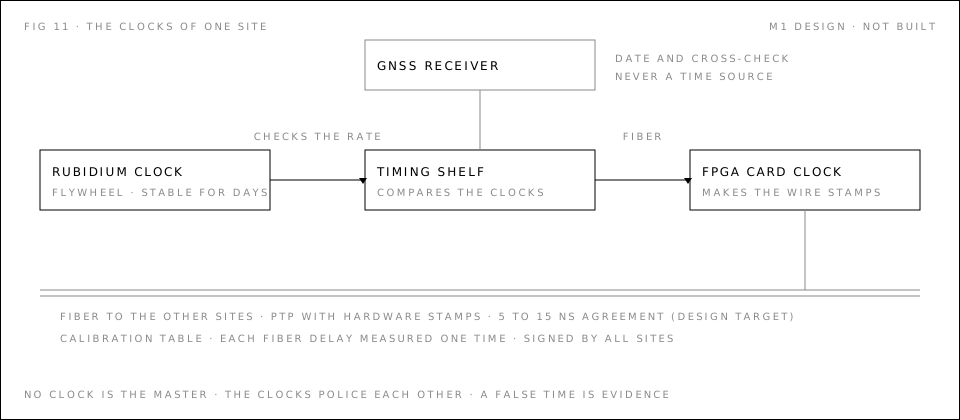
2.6 The atomic clock
This page explains the clocks of the sites in detail.
The idea
Each site keeps a rubidium atomic clock, which is stable for days. No site receives its time from another site. World time is not necessary for fair order. Clocks that agree with each other are necessary.
The sites measure each other's clocks through fiber. No clock is the master. A public rule calculates the official time from all clocks. A clock that gives a false time does not move the official time. It only shows itself.
Police from two directions
- From inside. The atomic clock of a site is a flywheel. It is stable, and it is difficult to push. If a person changes the GPS signal of a site, the GPS time goes away from the flywheel. The difference shows immediately.
- From outside. The other sites measure the clock of each site through the fiber. They compare the result with a signed table of fiber delays. Changes to the fiber or false stamps break this comparison.
A difference is evidence. A site signs each claim. Physics tests the claim. If a signed claim is physically impossible, it is a proof against the site, and it costs stake.
The parts
| Part | Function |
|---|---|
| PTP with hardware stamps | Clock messages between the cards. It measures offset and delay. |
| Rubidium clock (SRS FS725) | The local flywheel. It checks the rate of the clock of the card. |
| Timing shelf with three AMD Kria KR260 boards | Connects each rubidium clock to its card through fiber |
| GNSS receiver | Gives the date and a cross-check. We never use it as a time source. |
| Calibration | We measure the delay of each fiber one time and sign the table. |
The first production builds use PTP with hardware stamps, with a design target of 5 to 15 ns. White Rabbit technology from CERN can later give agreement below 1 ns.