2.2 Time and wire stamps
The wire stamp
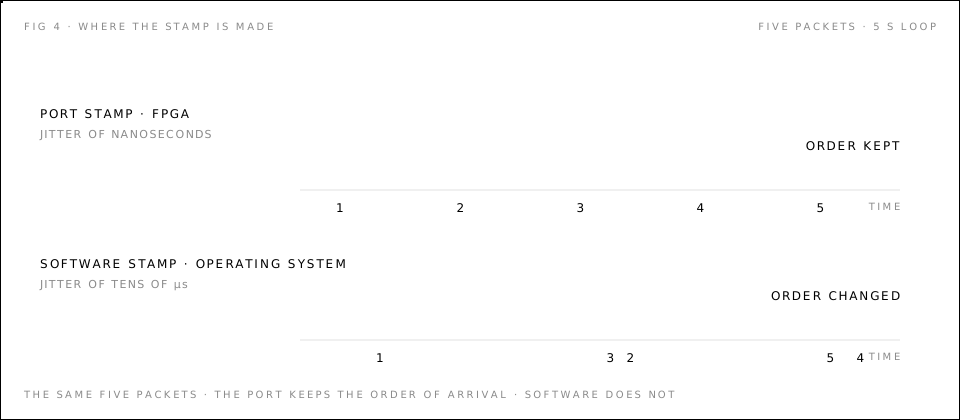
Each card has a counter that increases with its clock. When the first bits of an order come out of the light at the port, the card records the counter value. This value is the wire stamp.
- No operating system or software touches the order before the stamp. No software can add delay before the stamp.
- The host never sees the order before the stamp. The host cannot hold an order and give it an earlier time.
- The stamp goes into the signed output of the card. No person can change it later.
Software cannot be the witness. Between the wire and a program sit buffers, interrupts and schedulers. They add tens of microseconds of random delay. Six software observers of one packet give six different sequences. A stamp in the FPGA at the port has a precision of nanoseconds and a jitter of nanoseconds.
One time base for all sites
Six stamps are useful only if the six clocks agree. The design has three layers:
- Clock messages through the fiber. The cards exchange messages with hardware stamps (PTP) and measure their offsets. No clock is the master. The design target is agreement in 5 to 15 ns. White Rabbit technology can later give agreement below 1 ns.
- Calibration. The delay of each fiber link is measured one time, in a public ceremony, and all sites sign the table. With the table, each site converts the stamp of another site to its own time base.
- Atomic clocks. Each site has a rubidium atomic clock. It does not set the time. It checks the rate of the local clock. A clock that moves away from its atomic clock makes evidence against its site. Section 2.6 explains this.
Two notes
- Light in fiber goes approximately 5 µs for each kilometer. A near site sees an order before a far site. The rule corrects this with the calibration table. This is correct physics, and it is not a fault.
- World time is not necessary for fair order. The clocks must agree with each other only.