1.1 The objective
We build an exchange with a distributed sequencer, wire stamps and no front-running.
The problem
On an exchange, the order of arrival decides who trades first. Today, one company's server decides this order. No person outside the company can examine that decision.
- A person with an early or private view of the order flow can trade before other orders.
- Market makers know this risk. They quote wider prices, and the order book becomes thin.
- A venue that applies its rules correctly cannot prove this.
- Liquidity stays away from venues that it cannot check, and markets become disconnected.
How the design meets each objective
Section 1.2 tells how far the testnet is today.
| Objective | How |
|---|---|
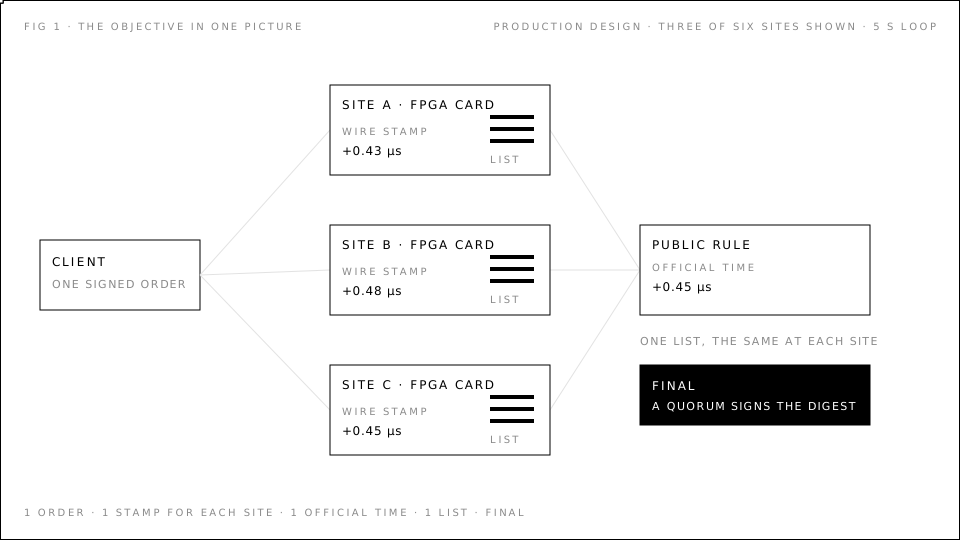
| Distributed sequencer | Each site has an FPGA card. Each card stamps each order. A fixed rule in the cards calculates the official time from all the stamps. No site is the master. |
| Wire stamps | The card records the time when the bytes of an order arrive at its network port. No operating system or software touches the order before the stamp. |
| No front-running | The official order follows the stamps. The sites sign the stamps and the results, and each batch names the rule. Each site executes the same list and signs the result. Any person can replay it. A site that gives false data makes evidence against itself and pays a penalty from its stake. |
The design is also made for low latency. Stamps, order, signatures and checks are in hardware, and the match is a few microseconds in software. Section 3.2 gives the measured latency and the design budget.
Why it matters
Our objective is fair and connected markets. Fair, because no person can move before your order after it arrives. Connected, because traders who can check the order of trades put their liquidity back on the venue.
Exchanges use FPGAs for speed. Blockchains use signatures. We use both for one purpose: an order of trades that no single operator controls, and that any person can check.