5.1 Hardware and roadmap
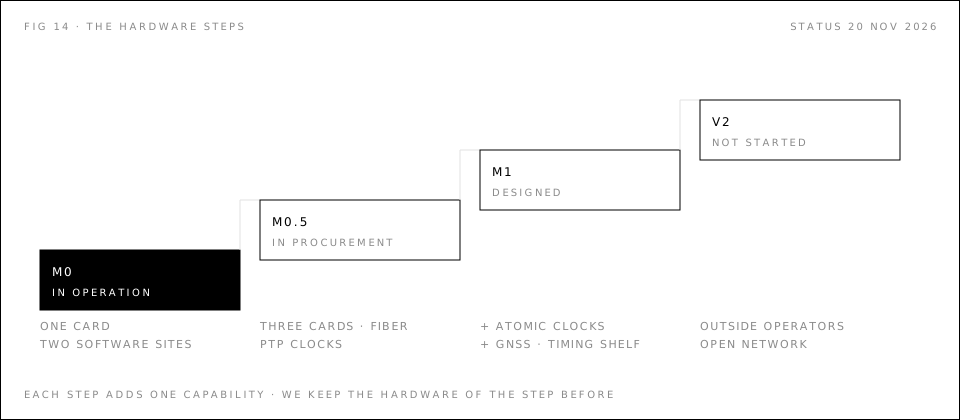
The hardware steps are the path to the objective: a distributed sequencer, wire stamps and no front-running. We build the hardware in four steps. Each step adds one capability. We keep the hardware of the step before.
| Step | Hardware | Clocks | Status |
|---|---|---|---|
| M0 | One U50 card (site 0) and two software sites | Each site counts its own time | In operation: runs the testnet |
| M0.5 | Three new servers, three U50 cards and one spare, fiber spools between the cards | PTP through the fiber, crystal clocks, 5 to 15 ns (design target) | In procurement. The spools passed the tests of the supplier. |
| M1 | M0.5 plus three rubidium clocks, a timing shelf and GNSS | Atomic clocks police each clock | Designed and quoted |
| V2 | Operators that we do not control | Atomic-policed | Not started |
What each step proves
- M0 proves that one FPGA card can stamp, sequence and sign batches for a live market. The 7-day run is the evidence. It does not prove clock synchronization or independent sites.
- M0.5 will prove clock synchronization in nanoseconds with no master clock, stamps in hardware at three sites, and consensus between three cards. The three spools are approximately 9.9 km, 4.9 km and 1.9 km. The different lengths make real optical delay part of each measurement. M0.5 does not prove clock policing, because a crystal clock cannot check its own rate.
- M1 will prove that atomic clocks find drift and false time, and make it evidence.
- V2 will prove that the network works when we do not control all the sites.
Roadmap
| Order | Step | Done when |
|---|---|---|
| 1 | New testnet chain | The chain runs, the bots quote, the reader verifies |
| 2 | Batches overlap again: remove the 134.5 ms wait for the certificate of the previous batch | We measure the full path at approximately 22.5 ms or less |
| 3 | Alerts that reach a person, and a check for slow sites | A test outage of a site makes an alert |
| 4 | Outside market makers and AI agents | Outside traders use the kit and agent connect |
| 5 | M0.5: three cards on fiber | Each card passes the physical test |
| 6 | Fiber calibration and PTP | We measure and publish the clock agreement |
| 7 | New ordering rule in the cards | Built, audited and live on a new chain |
| 8 | Low latency on the three cards | We measure the full path from the wire stamp to FINAL on the three cards, and we publish it |
| 9 | M1: atomic clocks | We test the faults on the physical setup |
| 10 | V2: outside operators | Operators that we do not control run sites |
Later items: a replacement for site 0 with no stop, keys that stay in the card, a matcher in hardware, more markets.