2.3.2 Timestamps
Each site gives one wire stamp to each order. The public rule combines the stamps into one official time. This page tells how the rule works, and what one false stamp can do.
The stamps
With six sites, an order has six stamps. The card of each site makes its stamp in hardware when the order arrives at its port. Each card writes a receipt for each order before it broadcasts its stamp. A site signs its receipts in groups. A site cannot change a stamp later.
One time base
The stamps of different sites are not on one clock. Each card converts a stamp of another site with two values. The first is the offset of the clock of that site, from the clock messages. The second is the fiber delay from the door to that site, from the calibration table. After this correction, the stamps of one order are close to each other. The distance between them is the noise of the clocks and the links.
The rule
The rule has three properties. Any person can check them from public data.
- No inversion. No site and no client can put a later order before an earlier order. "Later" means later by more than a published noise bound.
- No chosen ties. Orders that are closer than the bound are a group. Random data that no person knows at the time of the signature sets the order in the group.
- Accountability. If a site uses the small influence that it has, the published statistics of that site show it.
For each order:
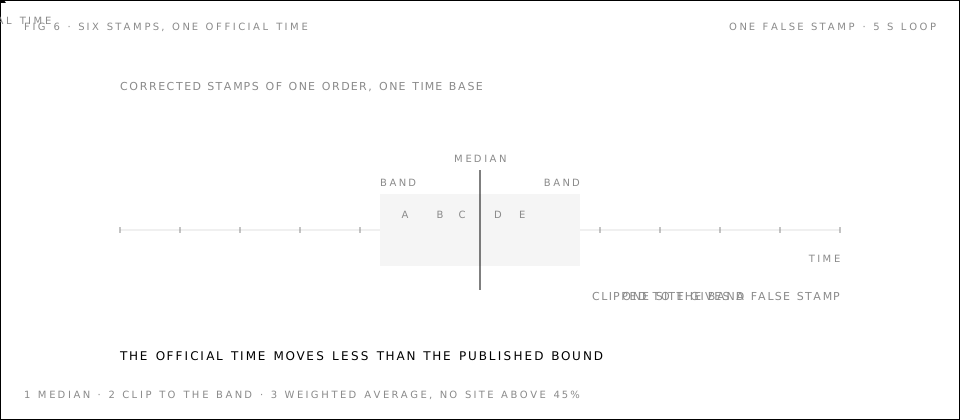
- Find the median of the corrected stamps. One false stamp cannot move the median outside the range of the correct stamps.
- Clip each stamp to a band around the median. The band is the distance between the stamps of one order on 99.9% of orders, measured in the previous period.
- Calculate a weighted average of the clipped stamps. A site with a more precise clock has more weight. No site has more than 45% of the weight.
The result is the official time. One false stamp can move it by a maximum of a published bound. In 200,000 tests of the rule in a software model, with one site that gives false stamps, the result stayed inside the bound every time.
Simultaneous orders
Two orders closer than the noise bound are simultaneous. No clock can tell which came first. The rule puts them in one group, and random data sets the order in the group.
The data comes from a hash of the group, or from a value that all cards calculate together. A client does not know the group when it signs. A site cannot select the value. Because of this, speed below the noise bound has no value.
What the rule publishes
Each period, the sites publish the noise bound, the band, the weights and the statistics of each site. A site that is always at the edge of its influence shows in the statistics (see 2.4).